Capital-Consumption Theory

Understanding the 80-Year Economic Cycle

A dynamical systems approach to macroeconomic fluctuations in post-industrial economies

Explore the Theory

The Theory

Bimodal Attractor System

Capital-Consumption Theory conceptualizes the economy as a bimodal attractor system oscillating between growth and stagnation states through self-reinforcing feedback loops.

Primary Feedback Loop

Consumer Income → Consumer Spending → Labor Demand → Wages → Consumer Income

Attractor States

Growth Attractor: Higher wages enable increased consumer spending, driving higher labor demand, pushing wages upward in a positive feedback loop.

Stagnation Attractor: Stagnant/falling wages restrict consumer spending, weakening labor demand, suppressing wages in a negative feedback loop.
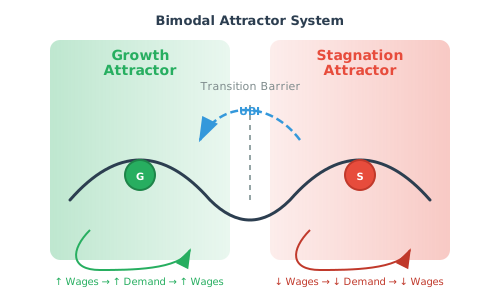
Bimodal Attractor System showing growth and stagnation states

The Evidence

80-Year Economic Cycle Timeline from 1900 to 2020s

Historical Cycle Analysis

The 80-year economic cycle can be observed through major economic transitions:

  • Great Depression Era (1929-1940s): High inequality, financial instability
  • Growth Period (1940s-1970s): Rising real wages, declining inequality
  • 1970s Transition Point: Inflationary pressures, policy shifts
  • Stagnation Period (1980s-2020s): Stagnant wages, rising inequality

Statistical Evidence

Using spectral analysis, panel cointegration techniques, and cross-spectral coherence measures on historical economic data, we demonstrate statistically significant periodicity at approximately 80 years.

View Detailed Evidence

Policy Implications

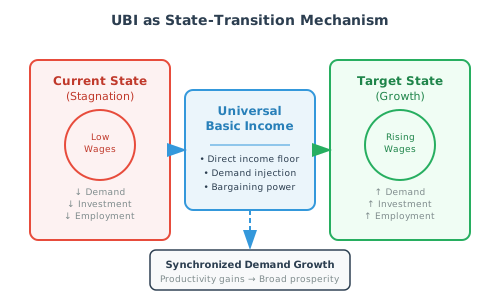
UBI as a Transition Mechanism

Universal Basic Income functions as a state-transition mechanism that can help shift the economic system from the stagnation attractor to the growth attractor.

Technology and Productivity

Our theory explains the paradox of productivity where technological advancement fails to generate broad-based prosperity when gains flow disproportionately to capital rather than labor.

UBI as State-Transition Mechanism diagram

Resources

Working Paper

Read the full theoretical paper on Capital-Consumption Theory, productivity growth, and income synchronization.

View Paper

Evidence

Explore the empirical data supporting the 80-year economic cycle hypothesis.

View Evidence